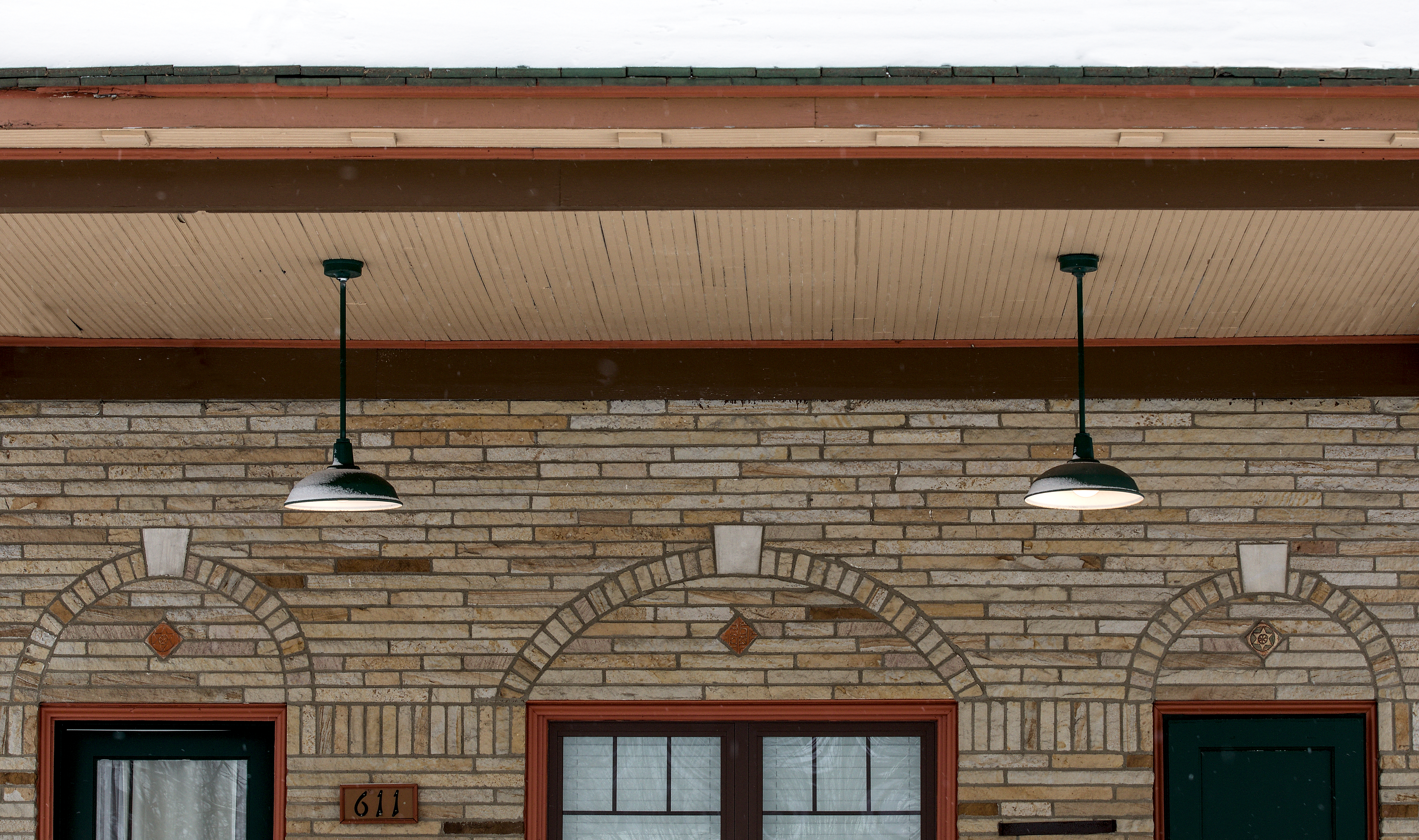
Suspended Symmetry
Framed in quiet winter light, this cropped study isolates the rhythm and symmetry of a downtown Muskegon façade, emphasizing the interplay between structural geometry and human-scaled details. The pendant lights, softly glowing against cold stone and carefully aligned brick arches, act as visual anchors, while the overhead canopy recedes with a shallow depth of field, reinforcing horizontal compression.
Though the building, which was relocated to 611 W Clay Avenue in 2004 no longer retains a singular documented civic function in public records, its architectural character recalls early-to-mid twentieth century American commercial design. The careful craftsmanship in masonry and arch articulation suggests its origins in the 1920s, later adapted for contemporary urban use.
In this composition, the absence of figures and the restrained palette allow form and surface to take precedence, transforming a utilitarian storefront into an abstract exploration of line, repetition, and minimal color against snow. The resulting image stands as both an architectural portrait and a study in quiet atmosphere.